Friday, 6 August 2010

Well Beeing

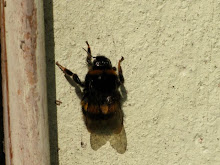
As all beekeepers know during the summer months worker bees live a productive, but very short life. Estimates vary, but in general they live for about 6 weeks. Although worker bees hatched at the end of the season could live through the winter. The Queen can live for up to 4 years. One beekeeping writer had pointed out that queen bees, unlike many other living things, have it both way: a long life and sexual reproduction. For the poor old worker bees we can say that they literally work themselves to death in the summer, which is a condition many of us can identify with. Many of us know what happen to the even less fortunate male drone bees.

Throughout the season I have seen few bodies of bees laying in my garden. From time to time, I have seen a few clawing aimlessly on the grass seemingly unable to fly. It is a pitiful sight. Of course I am concern that this may be something other then the end of its natural life cycle. There is always the fear that they may be affected by some unknown illness. If any reader of this blog have any information concerning this I would be grateful if you could drop me a line. Knowing what goes into producing a jar of honey ( about 20,000 bee miles) only make me more appreciative of these insects.

Friday, 23 July 2010

The House that bees built

These honey combs are the ones that the bees built underneath the hive (see previous post 11th July). After I removed them from below the mesh floor I placed them on the crown board and just let the workers get on with the job of cleaning them of the honey store.

This method of cleaning is also used on frames after honey was extracted. Last weekend I placed the frames (from Hv1) in Hv2 after I extracted the honey and when I inspected the hive today I could see all the frames are clean and repaired, and one of them already has new honey deposits in some of the cells. If only bees did house cleaning.

Today's inspection is also to see how this hive is developing. The good news is that the colony has increased in number, there are newly laid eggs and sealed brood cells. Although I did not see the queen I know from the eggs that she is around.

I am hoping that this hive and Hv1 will make enough honey for me to get another crop. The finally count of honey from Hv1 is 26 lb. Therefore I estimate there are roughly another 30 to 40 lbs of honey in the two hives. Of course most of these will be for the bees. My guess is that Hv1 almost certainly will fill another super, I am not sure if Hv2 (being small) will manage. We shall see.

Thursday, 22 July 2010

A Taste of Honey

This last week has been so busy I hardly had time to post the good news. Yes, you are looking at my first crop of honey. I collected it just over a week ago. It really was an exciting experience. The extraction process was a lot lot easier and less messy then I expected. I was given many good tips by other beekeepers, the most useful one is to have plenty of old newspapers handy to cover my kitchen floor.

This is genuine urban London (E17 to be precise) honey, and it is delicious. I collected just over 20 lb so far. I can't report the exact amount because I don't have a scale big enough to weight it. For the last weeks I have had the first lot of 'Friends of Chi's bees' collecting their first jar of honey. These Friends are people who donated a small amount of cash towards my first hive and had been waiting patiently for their honey. A big thank you for each and every one of them. Don't worry if you are a 'Friend' and you have not had yours yet, I shall be in touch.

In addition to this good news, the colony I hived (see previous posting) at Hv2 is doing well. Very well. Once again my friend Christine came and helped me to inspect the hive. We saw the queen and she is laying nicely. In a week or so there will be a whole lot more bees coming out of that hive. At present I estimate there is about another 30 lb of honey in the two hives. Of course I shall not be taking all of it as I must leave some for the bees for winter. There are now 2 supers on each of the hives and both hives have a near full one and a fairly empty one. So I am expecting another crop for collection before the summer ends. I am looking to get another 2o lb at least for the season, which is modest but good.

Sunday, 11 July 2010

The Gypsy Queen

The exceptionally hot days are continuing in London. This morning as planned I went and checked Hv2 to see what is happening to the remaining queen cell I left behind just over weeks ago.

Much to my surprise I found a number of new queen cells on some of the frames. The queen cell found has hatched, but no sign of the new queen. The brood frames are full of honey - too much honey I thought. I had to work out what to do next.

I set about to get rid of the new queen cells and on doing so discovered that they are empty but with lot of what I assumed to be royal jelly! One cell was sealed so I decided to leave this one and prepare to wait another week to see what will happen.

On closing the hive I happened to look down and saw what you can see in this photo: A massive cluster of bees hanging below the mesh floor! It was obvious to me a queen is there. The weight of the bees, pulling on the mesh floor, was leaving a gap from which they can enter and leave the brood chamber. This, I think, explains why there is so much honey in the brood frame. I believe that they were treating the brood box as a Super box. I think this may be the swarm that I thought I lost a few weeks ago. I shall know where to check in the future. Just to think of all places, this queen decided to camp outside the hive. It must be the Gypsy in her.

After a few phone calls, Olivia, a member from my local association came round with a mesh floor. With her help we hived the Gypsy queen colony back into HV2. They had built quite a few combs below the mash floor and were full of honey, but no eggs. While cutting these honey combs out I took time to look for the queen and found her trying to hid at one corner of mesh floor. She is a good looking queen. We shook her and the rest of the workers into the brood box. Having satisfied ourselves that we had her safely in the hive we closed up but before we did so I took out the sealed queen cell. It too was empty with just royal jelly.

One reader on this blog, from California, left a comment saying that the bees do keep me guessing. They certainly do my friend.

Thursday, 8 July 2010

Golden Brown

This (f0r my bee friends) is the first sight of surplus honey in one of my hive: Hv1, the original hive that I started my colony with. After a whole season last year without making surplus honey it now has, at last, producing a fair amount.

What you are looking at is honey cells waiting to be capped by the bees. They will do this when the level of moisture in the honey is just right so that when capped the honey will not ferment. We human would need a special instrument to do this while the bees just do what comes naturally.

In the photo you can see a few capped honey cells on the top of the frame. When most of the cells are capped I shall collect the honey. Already I am thinking where I can borrow a honey extractor to do the job. Meanwhile back at the bottom of my garden I am waiting for the queen cell in Hv2 to hatched. Last week I had an urgent call from one of my neighbours who said that he saw a swarm in his garden. This was surprising news to me as I had clear all but one queen cell and after checking most carefully at the hive I decided there is definitely no queen in the hive. No queen, no swarm. So where did that swarm came from.

I decided that the swarm my neighbour saw could be the 'original' swarm that I failed to catch over two weeks ago, or else it's someone else swarm. In any case it is definitely gone by now, which is a shame as I would live to catch it. I am turning my mind to the third season next year and I am planing, over this winter, to learn more about swarm prevention, this is something I had not done too well this year. On the bright side for now I have the honey to look forward to. Yum, yum.

Friday, 25 June 2010

A Swarm in June

" A swarm in May, a load of hay. A swarm in June, a silver spoon." - old proverb

The new colony Hv2 swarmed today. It was quite unexpected. One minute I was busy baking some bread the next thing I know my garden was once again filled with that loud humming sound. I saw a large cluster hanging from my buddleia bush. By the time I called round at my bee friends, Mike and Jenny, and returned with the borrowed nuc box, the swarm had gone from my back garden. I am very cross with myself. I can only take comfort from the fact that there is a swarm of my bees in the wild - free. I hope it is not caught.

I did a quick check of Hv2 and confirmed that it is indeed the source of the swarm: no eggs, no grubs, plenty of honey and some sealed brood cells. The last swarm in May had taught me the signs to look for. I found a number of queen cells and removed all but one (photo). This will be the new queen for the colony. I took time to make sure there is indeed no queen in the hive, so I just have to wait once more for the arrival of a new queen. What puzzles me is that the hive is far from being crowded - there are at least 4 frames that were not fully drawn. I shall have to speak with someone about this.

The good news is that the long awaited surplus honey is happening. In both hives there are clear sign of combs full of honey in the super. This evening I am going to pick up two more new super boxes and frames. I think things may be alright after all.

Wednesday, 16 June 2010

Found!

In the last few weeks I had been so busy that I hardly had time to update this blog even though I have been checking the hives to see how both are developing.

The good news is that I was wrong and HV1 has a queen after all. Last blog recorded that I put in a frame of eggs and brood from Hv2 into Hv1 hoping the workers will raise a queen bee, but this prove to unnecessary. When Christine and I checked HV1 just over two weeks ago much to our surprise we found another frame full with sealed brood cells. We quickly discount the possibility of laying worker as the sealed brood cells pattern was very evenly spread, which is very different to the pattern of the brood cells of laying worker bees. This meant we had in fact failed to spot any eggs when we checked the previous time and the queen is definitely was around.

Last Saturday we checked again and finally found the queen bee. We were delighted and agreed that she is very health and good looking. So at last I can relax. Had we not had a queen and the workers would not raise one I would have to consider either buying one in, or merge the two hive. So, all's well and ends well and the news of the the death of the queen in Hv1 was somewhat exaggerated.

Meanwhile I had a quick look at the super at Hv2 and found that the bees are busy drawing out the comb (photo) getting ready for storing honey - I hope. What happened to the the queen in HV1(when did it went out and mated?) and the old green queen is still a bit of a mystery, but this is half of the fun keeping bees I suppose. You keep them and keep you guessing.